The Battle of Saratoga convinced what European nation to join an alliance with the Patriots. *

11g. The Battle of Saratoga
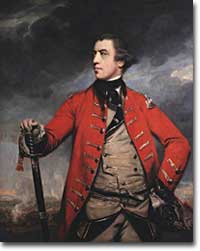
British general John Burgoyne earned the nickname "Gentleman Johnny" for his love of leisure and his tendency to throw parties betwixt battles. His surrender to American forces at the Battle of Saratoga marked a turning point in the Revolutionary War.
The Battle of Saratoga was the turning point of the Revolutionary State of war.
The scope of the victory is made clear by a few key facts: On Oct 17, 1777, 5,895 British and Hessian troops surrendered their arms. General John Burgoyne had lost 86 per centum of his expeditionary force that had triumphantly marched into New York from Canada in the early summer of 1777.
Divide and Conquer
The divide-and-conquer strategy that Burgoyne presented to British ministers in London was to invade America from Canada by advancing down the Hudson Valley to Albany. In that location, he would exist joined by other British troops under the command of Sir William Howe. Howe would be bringing his troops north from New Jersey and New York City.
Burgoyne believed that this bold stroke would not simply isolate New England from the other American colonies, but achieve command of the Hudson River and demoralize Americans and their would-exist allies, such equally the French.
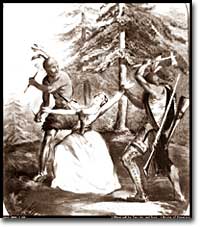
Some historians today are unsure if her death came at Native American easily or by other means, but the murder of Jane McCrea united Americans confronting the British and their Native American allies.
In June 1777, Burgoyne's army of over 7,000 men (half of whom were British troops and the other half Hessian troops from Brunswick and Hesse-Hanau) departed from St. Johns on Lake Champlain, bound for Fort Ticonderoga, at the southern end of the lake.
As the army proceeded due south, Burgoyne drafted and had his men distribute a proclamation that, among other things, included the argument "I have just to give stretch to the Indian forces under my direction, and they amount to thousands," which implied that Britain'southward enemies would suffer attacks from Native Americans centrolineal to the British.
More than whatsoever other human activity during the campaign, this threat and subsequent widely reported atrocities such as the scalping of Jane McCrea stiffened the resolve of the Americans to do any information technology took to assure that the threat did non go reality.
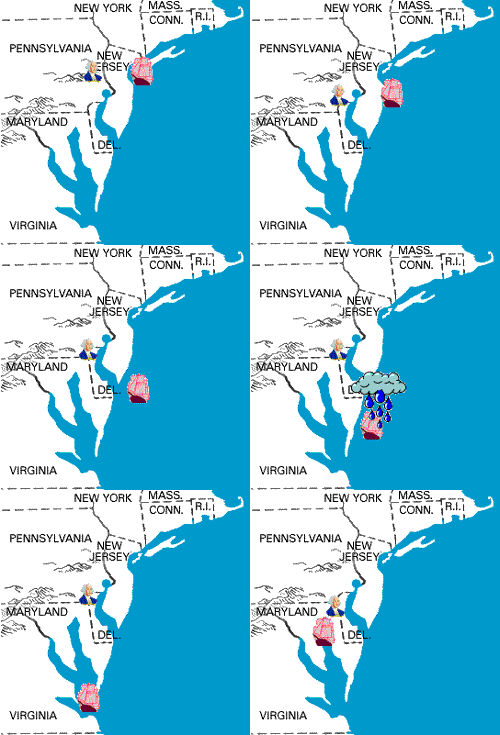
Instead of heading north to help Burgoyne fight the rebels in Saratoga, General Howe sailed south and embarked on a campaign to capture Philadelphia.
Round One to the British
The American forces at Fort Ticonderoga recognized that once the British mounted arms on high ground near the fort, Ticonderoga would be indefensible. A retreat from the Fort was ordered, and the Americans floated troops, cannon, and supplies across Lake Champlain to Mountain Independence.
From there the army set out for Hubbardton where the British and High german troops caught up with them and gave boxing. Round ane to the British.

Burgoyne continued his march towards Albany, merely miles to the south a disturbing event occurred. Sir William Howe decided to set on the Rebel capital at Philadelphia rather than deploying his ground forces to meet up with Burgoyne and cutting off New England from the other Colonies. Meanwhile, equally Burgoyne marched south, his supply lines from Canada were becoming longer and less reliable.
Bennington: "the compleatest Victory gain'd this War"
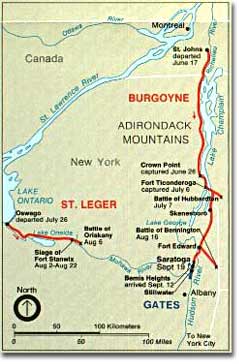
Equally Burgoyne and his troops marched down from Canada, the British managed to win several successful campaigns besides as infuriate the colonists. Past the time the Burgoyne reached Saratoga, Americans had successfully rallied support to beat him.
In early August, word came that a substantial supply depot at Bennington, Vermont, was declared to exist lightly guarded, and Burgoyne dispatched German language troops to have the depot and return with the supplies. This time, nevertheless, stiff resistance was encountered, and American full general John Stark surrounded and captured well-nigh 500 German soldiers. One observer reported Bennington as "the compleatest Victory gain'd this War."
Burgoyne now realized, too late, that the Loyalists (Tories) who were supposed to have come to his aid by the hundreds had non appeared, and that his Native American allies were also undependable.
American general Schuyler proceed to fire supplies and crops in the line of Burgoyne'south advance so that the British were forced to rely on their e'er-longer and more than and more unreliable supply line to Canada. On the American side, General Horatio Gates arrived in New York to take command of the American forces.
Battle of Freeman'south Farm
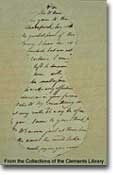
Mask letters, invisible ink, and surreptitious code are the tricks of the trade for any adept spy. Loyalist Henry Clinton used a mask letter to communicate with Burgoyne.
By mid-September, with the fall weather reminding Burgoyne that he could non winter where he was and needed to go on apace toward Albany, the British army crossed the Hudson and headed for Saratoga.
On September 19 the two forces met at Freeman's Farm north of Albany. While the British were left as "masters of the field," they sustained heavy human losses. Years later, American Henry Dearborn expressed the sentiment that "we had something more at stake than fighting for six Pence pr Day."
Battle of Saratoga
In late September and during the showtime week of Oct 1777, Gate'due south American regular army was positioned between Burgoyne'due south army and Albany. On October 7, Burgoyne took the offensive. The troops crashed together due south of the town of Saratoga, and Burgoyne'southward army was broken. In mop-upwardly operations 86 percent of Burgoyne's command was captured.
The victory gave new life to the American cause at a critical time. Americans had only suffered a major setback the Battle of the Brandywine along with news of the fall of Philadelphia to the British.
One American soldier declared, "It was a glorious sight to run across the haughty Brittons march out & give up their arms to an army which only a piddling earlier they despised and called paltroons."
A stupendous American victory in October 1777, the success at Saratoga gave France the confidence in the American cause to enter the war every bit an American ally. Later American successes owed a great deal to French aid in the course of financial and armed services assistance.
A Word virtually Spies
Spies worked for both British and American armies. Secret messages and battle plans were passed in a variety of artistic ways, including existence sewn into buttons. Patriots and loyalists penned these secret letters either in lawmaking, with invisible ink, or as mask letters.
Hither is an example of Loyalist Sir Henry Clinton's mask letter. The starting time letter is the mask letter with the hugger-mugger bulletin decoded; the second is an excerpt of the full letter of the alphabet.
Benedict Arnold
Benedict Arnold is best remembered as a traitor; an American patriot who spied for the British during the American Revolution. But there is more to his story than this sorry event.
Arnold was a fierce patriot during the Postage Act crisis and the early on years of the American Revolution. During the battles of Lexington and Concur, Arnold worked with Ethan Allen to capture Fort Ticonderoga and was named a colonel.
As a member of George Washington's Continental Army, he led a failed attack on Quebec, but was nonetheless named brigadier full general in 1776.
His next big moment came at the Battle of Saratoga. Here, Benedict Arnold was instrumental in stopping the advance of the British and in obtaining the give up of British General John Burgoyne.
During the Boxing of Freeman's Subcontract, Arnold'due south leg was severely wounded when pinned below his horse. (Both Arnold and his leg survived, there is a monument to his leg at Saratoga National Historic Park.)
Over the adjacent two years, Benedict Arnold remained a patriot, but was upset and embittered at what he felt was a lack of his recognition and contribution to the war. In 1778, following British evacuation of Philadelphia, George Washington appointed Arnold military commander of the city.
This is where the story gets interesting.
In Philadelphia, Benedict Arnold was introduced to and fell in honey with Margaret (Peggy) Shippen, a immature, well-to-do loyalist who was one-half his age. Ms. Shippen had previously been friendly with John André, a British spy who had been in Philadelphia during the occupation equally the adjutant to the British commander in principal, Sir Henry Clinton. It is believed that Peggy introduced Arnold to André.
Meanwhile, Benedict Arnold's reputation while in Philadelphia was first to tarnish. He was accused of using public wagons for individual turn a profit and of being friendly to Loyalists. Faced with a courtroom-martial for corruption, he resigned his mail service on March 19, 1779.
Following his resignation, Arnold began a correspondence with John André, at present chief of British intelligence services. But Arnold had also maintained his shut human relationship with George Washington and still had admission to important information. Over the next few months Bridegroom Arnold continued his talks with André and agreed to manus over central information to the British. Specifically, Arnold offered to hand over the most strategic fortress in America: West Point.
Arnold and André finally met in person, and Arnold handed over information to the British spy. But, unfortunately for both men, André was defenseless and Arnold'southward alphabetic character was institute. Arnold'due south friend, George Washington, was heartbroken over the news, but was forced to deal with the treacherous act. While Benedict Arnold escaped to British-occupied New York, where he was protected from penalisation.
John André was executed for spying.
Benedict Arnold was named brigadier general by the British government and sent on raids to Virginia. Following Cornwallis'south give up at Yorktown in 1781, Arnold and his family sailed to Uk with his family. He died in London in 1801.
Source: https://www.ushistory.org/us/11g.asp
0 Response to "The Battle of Saratoga convinced what European nation to join an alliance with the Patriots. *"
Post a Comment