what does the nervous system need to function
Acquire primal MCAT concepts about the nervous system, plus practice questions and answers

(Note: This guide is office of our MCAT Biology series.)
Tabular array of Contents
Role ane: Introduction to the nervous arrangement
Part two: Divisions of the nervous system
a) Central and peripheral nervous systems
b) Autonomic and somatic nervous systems
c) Sympathetic and parasympathetic nervous systems
Part three: Microanatomy
a) Anatomy of a neuron
b) Cells of the nervous system
c) The action potential
d) Neural impulses and neurotransmitters
Part four: Types of neurons
a) Afferent and efferent neurons
b) Upper and lower motor neurons
Part 5: High-yield terms
Part 6: Passage-based questions and answers
Office 7: Standalone questions and answers
Part 1: Introduction to the nervous system
From assuasive you to perceive your surroundings to remembering your life's most memorable moments, the nervous system can perform some of the most marvelous feats of any organ system. Unfortunately, studies show that many neurological disorders are on the rise. The incidence of Alzheimer's disease, for example, is expected to triple by 2050. Thus, it is more vital than ever that the physicians of tomorrow are equipped with the noesis needed to care for this growing group of patients.
The information presented in this guide volition describe cardinal aspects of the nervous system that are relevant to biology and biochemistry. To ameliorate empathise the office of the nervous system, be sure to refer to our Psychology and Folklore guides on Psychological Disorders and Behavior and Biology.
Throughout this guide, y'all will see several terms in bold. Exist sure to understand these concepts well! At the finish of the guide, there will also be several MCAT-style practice issues you tin can employ to examination your knowledge.
Let'due south get started!
Part ii: Divisions of the nervous system
The nervous system is responsible for a variety of functions. Its chief function is to provide control between different body systems. The nervous arrangement serves to integrate information from a variety of body systems, including information well-nigh the external environment that is carried into the trunk, and to coordinate responses that maintain internal homeostasis and proper cellular role.
a) Primal and peripheral nervous systems
The nervous system can exist divided into 2 major components. The encephalon and spinal string comprise the primal nervous system, while nerves and ganglia outside the brain and spinal cord make upwardly the peripheral nervous system.
The outermost office of the encephalon is the cerebral cortex. This layer merits special attention because it is responsible for many of our college cognitive functions. The cerebral cortex is rich in the cell bodies, or soma, of neurons. These neurons have long axons that extend through the encephalon and into the spinal string.
The cerebral cortex tin itself be divided into four major lobes, each with loosely specialized functions.
-
The frontal lobe governs executive role, initiates voluntary motor movement, and is responsible for producing speech.
-
The parietal lobe governs spatial processing, proprioception, and somatosensation.
-
The occipital lobe governs visual processing.
The temporal lobe governs learning, retention, speech perception, and auditory perception. An important linguistic communication center known equally Wernicke's area is located here.
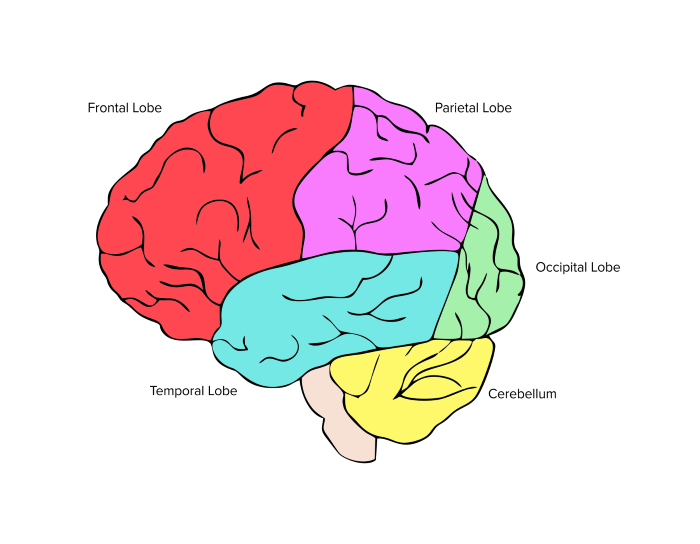
Figure: Lobes of the cerebral cortex
Each hemisphere, or side, of the brain is also loosely specialized. The left side of the brain processes sensory data from the correct side of the trunk and is as well the primary hemisphere used in performing math and science problems, logical reasoning, and analytical thinking. The right hemisphere of the brain processes sensory information from the left side of the body and is too the primary hemisphere used in spatial awareness, emotional intelligence, intuition, and holistic thinking.
How practice these two hemispheres communicate with each other? A construction called the corpus callosum forms a bridge between the left and right hemispheres of the brain. The nerves inside the corpus callosum let sensory information from i side to "cross" to the opposite hemisphere, where it tin can exist processed. Thus, any environmental cues that are sensed by the right side of the body are sent to the left hemisphere of the brain for processing, and vice versa.
b) Autonomic and somatic nervous systems
The peripheral nervous system can be divided into the autonomic and somatic nervous systems. The autonomic nervous system is responsible for regulating the involuntary activities of the body, such equally heartbeat, breathing, digestion, and internal body temperature. The autonomic nervous system works closely with a variety of other actual systems, including the gastrointestinal organisation and endocrine organization. The nervous and endocrine systems integrate closely with each other nether feedback control, which results in the stimulation or repression of activation due to the nervous system in response to endocrine products. (For more information on this, be sure to refer to our guide on the endocrine system.)
Conversely, the somatic nervous system is primarily associated with the body's voluntary movements, including skeletal muscle contraction and relaxation.
c) Sympathetic and parasympathetic nervous systems
The autonomic nervous organization tin be divided into the parasympathetic and sympathetic nervous systems. The parasympathetic nervous arrangement is often chosen the "rest and digest system" as information technology is responsible for digestive processes, such equally peristalsis, and slumber-promoting processes, such as slowing the heart rate. The sympathetic nervous system is responsible for the "fight-or-flight" response. The action of the sympathetic nervous system triggers the release of cortisol and epinephrine from the adrenal glands. These hormones and neurotransmitters work together to keep the torso alert and prepared to face up a stressor, such as past inhibiting digestion, releasing stress hormones, and increasing your heart rate.
Both of these systems are combative to, or oppose, each other.

Figure: Organization of the nervous system
Part 3: Microanatomy
a) Anatomy of a neuron
The neuron is the workhorse cell of the nervous system. It is characterized past its power to communicate with other cells using electrical impulses and chemic signals. It contains many different components that you should be familiar with for test day.
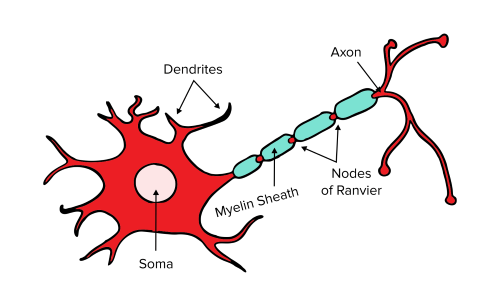
Effigy: Schematic of a single neuron.
The cell body, or the soma, contains the nucleus, endoplasmic reticulum, and ribosomes of the neuron. Dendrites are outgrowths that branch off from the cell torso to receive signals. Axons are long extensions that send signals to other cells via action potentials, which is the electrical impulse neurons utilize for communication.
A huge variety of helper cells assist in maintaining the structure and role of neurons. To maintain the integrity of the electrical signal and increment conduction speed, oligodendrocytes in the CNS and Schwann cells in the PNS produce myelin—an outgrowth of the helper cell's plasma membrane—to insulate nerve fibers. Myelin is tightly wrapped around the axon to form sections of insulated axon. The spaces between various sections of myelin sheath are called nodes of Ranvier. These exposed areas of the axon membrane allow for high conduction speeds past assuasive the signal to "hop" from node to node, a miracle called saltatory conduction.
Signals are passed from neuron to neuron through the synapse, which is fabricated up of the presynaptic neuron'due south nervus terminal, a space called the synaptic cleft, and the postsynaptic neuron's membrane.
Over fourth dimension, neurons brainstorm to class interconnected pathways that strengthen learned noesis. This is referred to as synaptic plasticity. Over time, pathways and encoded memories that are used more often will strengthen; pathways that are used less often will weaken. In some cases, unabridged pathways may die abroad in a process known as synaptic pruning.
Most neurons in active pathways must remain in place for equally long as possible. Neurons generally do not undergo mitosis and instead remain in a senescent land for most of one's lifetime.
b) Cells of the nervous system
While neurons are the functional jail cell of the nervous system, they are non the only blazon of cell present. Neuroglia, or glial cells, are a diverse and important group of cells that support neurons. The table below summarizes these cells, their functions, and if they are specific to the central or peripheral nervous arrangement.
| Location | Proper name | Functions |
|---|---|---|
| | | |
| | | |
| | | |
| | | |
| | | |
c) The activeness potential
As we've discussed, neurons transmit information through electrical signals, called activeness potentials, which release neurotransmitters from the presynaptic neuron. The generation of an action potential occurs segmentally and tin be divided into four steps: rest, depolarization, repolarization, and hyperpolarization.
When a neuron is at residual (east.g., when an action potential has not yet "fired"), it has a membrane potential of -70 mV. This is due to the presence of charged particles both inside the jail cell and in the extracellular fluid, including mineral ions and charged proteins. The charges of particles both inside and outside of the cell create an electrical potential across the cellular membrane.
There is a higher concentration of potassium ions within of the cell compared to the outside of the cell. Potassium leak channels in the membrane allow the positively charged potassium ions to menstruation out of the jail cell, which contributes to a net negative charge on the within of the cell. Conversely, there is a college concentration of sodium ions outside of the prison cell compared to the inside of the prison cell. Sodium leak channels allow positively charged sodium ions to flow into the jail cell, which partly counters the effects of the outward menses of potassium ions and gives us the -70 mV resting membrane potential. This resting membrane potential is maintained by the sodium-potassium pump, an ATP-dependent enzyme that facilitates the balancing act betwixt sodium and potassium ions. It pumps out three sodium ions for every 2 potassium ions pumped into the prison cell.
Inhibitory signals decrease the membrane potential of a neuron through hyperpolarization, or force the membrane potential to get more than negative (e.1000., less than -seventy mV). Conversely, excitatory signals increase the membrane potential of a neuron via depolarization, or force the membrane potential to become more positive (e.thousand., greater than -seventy mV). Once the membrane voltage increases to the threshold value at around -50mV, voltage-gated sodium channels open and let an influx of sodium ions into ane segment of the axon. (Note that reaching the threshold value is an all-or-goose egg event: in one case the threshold value is crossed, the rest of the activity potential is guaranteed to burn.) This causes further depolarization until the membrane potential reaches around +35mV to 40mV. This also results in the depolarization of an adjacent segment of the axon.
One time the neuron reaches a membrane potential of +35mV to 40mV, repolarization begins. Now, K+ ions can flow out of the cell as voltage-gated potassium channels open while sodium channels are inactivated. This causes the membrane potential to decrease.
Equally the potassium ions go along to flow out of the cell, the membrane potential actually becomes lower than the resting potential of -70 mV. This places the neuron into an absolute refractory period, during which no stimuli can trigger some other action potential.
The sodium-potassium pump also works to restore the resting membrane potential. Think that for every ane molecule of ATP that is hydrolyzed, 3 Na+ ions are pumped out of the cell and two Chiliad+ ions are pumped back in. The cell transitions to the relative refractory period, during which an activeness potential tin occur but if the stimulus is greater than usual.

Figure: Voltage changes during an action potential.
Recall that neural impulses are transmitted segmentally in the axon. The influx of sodium ions in one segment during the depolarization phase changes the membrane potential along a short portion of the membrane, thus causing voltage-gated sodium channels in the side by side segment to open. As the next sodium channels open, depolarization of the membrane causes the cell potential to laissez passer the threshold value. This process continues equally the neural impulse propagates forth an axon.
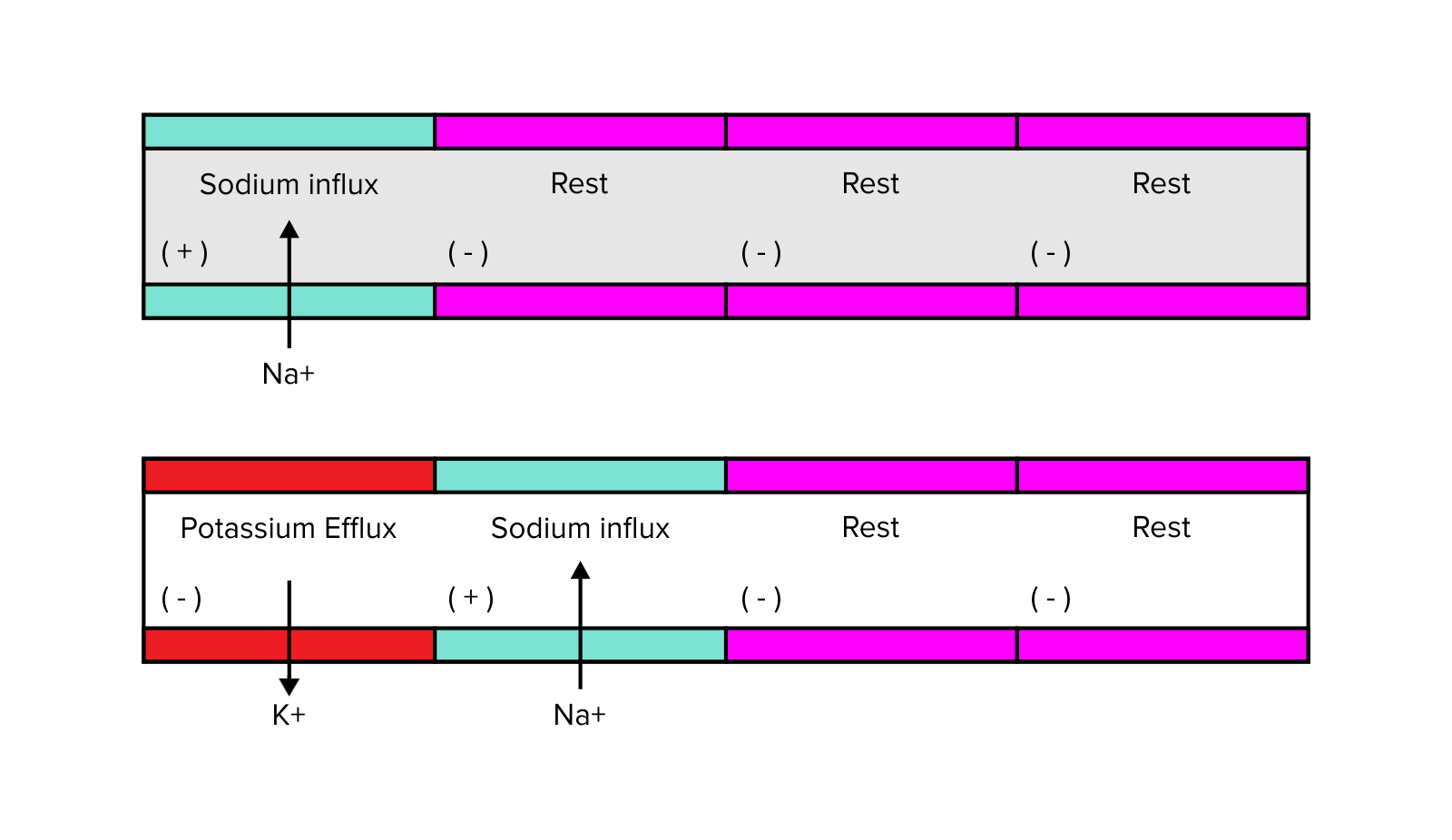
Figure: Propagation of an action potential along an axon
d) Neural impulses and neurotransmitters
The propagation of neural impulses can occur electrically or chemically. Electrical synapses are less mutual and are primarily carried out through gap junctions in cardiac cells. (For more information on the electric pathways of the centre, be sure to refer to our guide on the respiratory and cardiovascular systems.) Since electric synapses exercise not require the menstruum of chemicals, they are bidirectional and significantly faster than chemical synapses.
Chemical synapses, on the other manus, are the most common manner neural impulses are propagated between cells. The exchange occurs at a synapse, or coming together of two neurons. This meeting generally occurs between the terminus, or end, of the axon of a presynaptic neuron and the dendrites of a postsynaptic dendrite.
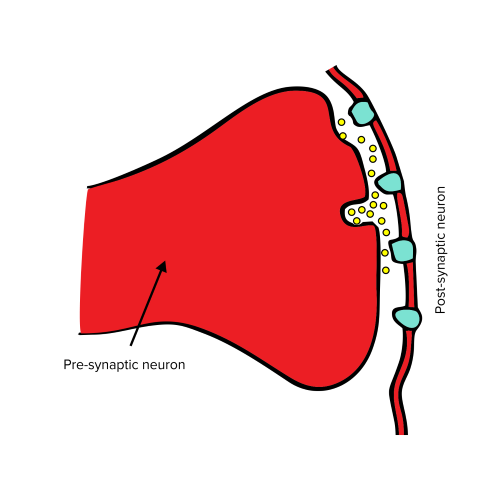
Figure: A synaptic crevice.
Chemical synapses are based on the release of neurotransmitters: minor-molecule chemical messengers. At the nerve terminal of the presynaptic neuron, the activeness potential triggers the influx of calcium ions by opening voltage-gated calcium channels. This causes membrane-bound vesicles to release neurotransmitters into the synaptic fissure. The neurotransmitters then bind to receptors on the membrane of the postsynaptic neuron.
The function of each neurotransmitter volition straight affect the behavior of the postsynaptic neuron. If the neurotransmitter is excitatory, the postsynaptic neuron will be stimulated to produce its own action potential. If the neurotransmitter is inhibitory, the postsynaptic neuron will be blocked from producing an action potential.
Multiple electric signals sent into the same synaptic crevice can as well sum together to course a larger electrical stimulus. This summation tin occur in one of several means. Temporal summation results from the additive effects of ane axon concluding sending repeated, smaller excitatory signals in close succession. Spatial summation results from the additive effects of multiple axon terminals sending multiple smaller excitatory signals to the region around a single post-synaptic neuron.
Neurotransmitters tin can be removed from the synaptic scissure through i of three possible mechanisms. During reuptake, a neurotransmitter is shuttled into the presynaptic neuron through a transporter on its membrane. In enzymatic degradation, a neurotransmitter is cleaved down by an enzyme. During improvidence, a neurotransmitter diffuses out of the synaptic fissure and abroad from the receptors on the postsynaptic neuron. Diffusion is typically the slowest process of neurotransmitter removal, equally it depends on the spontaneous flow of molecules down a chemic gradient.
| Proper name | Regulatory Role | Chief Functions | Location | Disorders associated with deficit |
|---|---|---|---|---|
| | | | | |
| | | | | |
| | | | | |
| | | | | |
| | | | | |
| | | | | |
| | | | | |
Part 4: Types of neurons
a) Afferent and efferent neurons
Afferent neurons, or sensory neurons, ship signals to the brain and spinal cord from sensory receptors. Efferent neurons, or motor neurons, send motor information from the encephalon and spinal cord to effectors, such as muscles. (Information technology may be helpful to use this mnemonic: afferent fretfulness arrive at the encephalon, while efferent nerves exit.)
Interneurons are neurons that office as intermediaries between afferent and efferent neurons. Interneurons are most notable for their office in reflexes. An afferent neuron may transport a point to an interneuron in the spinal cord, which tin can quickly send a betoken to an efferent neuron; this is a process that can occur in the spinal cord without the intervention of the brain.
The nearly common instance of this is the withdrawal reflex. If you were to accidentally place your hand on a hot stove, afferent neurons would send the sensory signals of temperature and pain to interneurons in your spinal cord that are also linked to efferent neurons. The efferent neurons are able to coordinate multiple muscles so that you lot retract your paw chop-chop rather than waiting for the signals to achieve the brain. This is a type of polysynaptic reflex arc as information technology involves at to the lowest degree 1 interneuron linking afferent and efferent neurons. Monosynaptic reflex arcs, on the other hand, consist only of an afferent and efferent neuron with i synapse. A common example of this is the knee joint-jerk reflex, during which afferent neurons in the knee joint synapse with an efferent neuron in the spinal cord. This stimulates muscles in the leg, causing it to extend.
Although reflexes are fast and efficient at removing the states from sources of danger, the motions they crusade are often imprecise and wide.
b) Upper and lower motor neurons
Motor neurons can be further classified into two chief categories: upper motor neurons and lower motor neurons. In a nutshell, upper motor neurons in the cerebral cortex transmit information to lower motor neurons in the spinal cord. Lower motor neurons and then meet the skeletal muscle at neuromuscular junctions, which stimulates muscular wrinkle.
Defects of upper motor neurons are associated with four primary abnormalities, or signs. These signs can be thought of as a result of "overstimulation" of the lower motor neuron: a defect in the upper motor neuron causes an abnormally big number of stimulatory signals to be sent to the lower motor neuron.
-
Hyperreflexia: Hypersensitive receptors in muscles result in greater stretch reflexes
-
Hypertonia: Increased muscle tension and tightness inhibits muscles from being able to stretch fully
-
Clonus: repeating muscular contractions and relaxations
-
Extensor plantar response: Stimulation of the bottom of the pes causes the toes to extend upward when normally they should exhibit a downward response
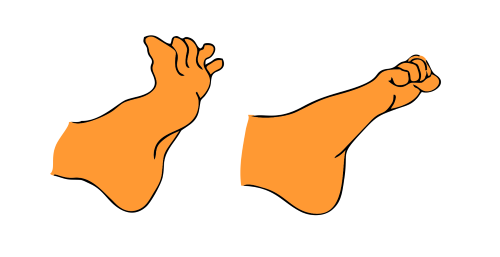
Effigy: Extensor plantar response (left); normal response (right)
Defects of lower motor neurons are associated with four primary abnormalities, or signs. These can exist idea of as the issue of a lack of receptivity past the lower motor neuron. Defects in the lower motor neuron weaken the resulting indicate to the muscle it meets.
-
Hyporeflexia: Diminished receptor sensitivity in muscles resulting in decreased stretch reflexes
-
Hypotonia: Decreased muscle tension and tightness, which inhibits muscles from beingness able to stretch fully
-
Fasciculations: Spontaneous, involuntary muscle twitching
-
Muscular atrophy: Degradation of skeletal muscle
Acknowledgements: Sahil Chawla
Part 5: High-yield terms
Corpus callosum: a nervus tract that forms a bridge between the left and right hemispheres of the brain
Parasympathetic nervous system: responsible for the "rest and digest" response
Sympathetic nervous system: responsible for the "fight-or-flying" response
Dendrites: branch off from the neuronal cell body to receive signals
Axons: long extensions of the neuron that send signals to other cells
Neuroglia: a various and of import group of cells that back up neurons
Sodium-potassium pump: hydrolyzes 1 ATP to pump iii sodium ions out of the cell and two potassium ions into the cell
Absolute refractory flow: period during which no stimuli tin can trigger some other activeness potential
Relative refractory menstruum: menstruum during which an activity potential can occur only if the excitatory stimulus is greater than usual
Synapse: meeting of ii neurons that more often than not occurs betwixt the terminate of a presynaptic axon and postsynaptic dendrite
Neurotransmitters: minor-molecule chemical messengers that pass betwixt neurons at a synapse
Reuptake: procedure of neurotransmitter removal in which a neurotransmitter is shuttled into the presynaptic neuron through a transporter on its membrane
Afferent neurons: sensory neurons
Efferent neurons: motor neurons
Polysynaptic reflex arc: reflex arc that involves at least one interneuron linking afferent and efferent neurons
Monosynaptic reflex arcs: reflex arcs with simply one synapse between an afferent and efferent neuron
Upper motor neuron: efferent neurons that synapse from the encephalon into the spinal string
Lower motor neuron: efferent neurons that synapse from the spinal string onto the neuromuscular junction
Part 6: Passage-based questions and answers
Demyelinating diseases cause destruction of the myelin sheath. Demyelination can be the event of an inflammatory process, viral infection, acquired metabolic derangement, or cardiovascular disruption. Diseases that can cause inflammatory demyelination of the CNS include multiple sclerosis (MS), acute disseminated encephalomyelitis (ADEM), and acute hemorrhagic leukoencephalitis. Demyelinating diseases tin also crusade astute respiratory failure when the spinal string is afflicted.
A 17-twelvemonth-erstwhile Greek female was hospitalized in the ICU due to acute respiratory failure requiring mechanical ventilation. The patient had a history of delirious disease one calendar month previous to the visit, which included an acute onset of paraplegia, diplopia, progressive one-sided arm weakness, and dyspnea. A demyelinating peripheral nervous organisation (PNS) illness was determined to exist the underlying status.
An MRI of the brain revealed the presence of lesions involving the optic nerve, basal ganglia cerebellum, pons, and medulla oblongata. In that location was also extended involvement along the spinal string. Further, blood piece of work revealed elevated counts of white claret cells within the cerebrospinal fluid.
The patient required mechanical ventilation for two months. Then she was transferred to a rehabilitation heart. Iii years later she remains paraplegic. Since and then, she has not suffered any other demyelination attack.
CREATOR AND ATTRIBUTION PARTY: KATSENOS, C., ANDROULAKI, D., LYRA, S. ET AL. A 17 YEAR-Quondam GIRL WITH A DEMYELINATING DISEASE REQUIRING MECHANICAL VENTILATION: A Case REPORT. BMC RES NOTES 6, 22 (2013). THE ARTICLE'S FULL TEXT IS AVAILABLE Here: TTPS://BMCRESNOTES.BIOMEDCENTRAL.COM/Articles/x.1186/1756-0500-6-22. THE Article IS Not COPYRIGHTED By SHEMMASSIAN ACADEMIC CONSULTING. DISCLAIMER: SHEMMASSIAN ACADEMIC CONSULTING DOES Not Own THE PASSAGE PRESENTED Hither. CREATIVE Mutual LICENSE: HTTP://CREATIVECOMMONS.ORG/LICENSES/BY/4.0/. CHANGES WERE MADE TO ORIGINAL ARTICLE TO CREATE AN MCAT-Fashion PASSAGE.
Question 1: Based on the data in the passage, which of the following is a possible outcome of the patient's underlying status?
A) Decreased synaptic speed
B) Decreased conduction speed of electrical signals
C) Increased sensitivity in extremities
D) Decreased rates of noesis
Question 2: The structures that received damage in this patient are near directly responsible for which of the following functions?
A) Sending signals to other cells
B) Receiving signals from other cells
C) Synthesizing protein
D) Housing genetic textile
Question 3: The patient'due south arm weakness is nearly likely due to a defect in which of the following structures?
A) Afferent neurons in the central nervous system
B) Efferent neurons in the peripheral nervous system
C) Sensory neurons in the peripheral nervous system
D) Interneurons in the spinal string
Question 4: Co-ordinate to the information presented in the passage, damage to which of the following structures would effect in the physical symptoms presented past this patient?
A) Schwann cells
B) Oligodendrocytes
C) Upper motor neurons
D) Lower motor neurons
Question 5: Which of the following accurately describes the relative refractory menses after an action potential?
A) An action potential is unable to exist generated again by any stimulus
B) An action potential is able to be generated again by a weaker stimulus
C) An activeness potential is able to be generated once again by a stronger than usual stimulus
D) An action potential is able to be generated again by a normal stimulus, but information technology becomes more energetically costly
Answer key for passage-based questions
-
Answer choice B is correct. The passage states that the patient has an underlying demyelinating fundamental nervous system disease. Myelin insulates nerve fibers, which increases the conduction speed of electrical signals along the length of axons. Thus, there would exist a conduction speed along the length of the axon (choice B is correct). Since demyelination does not touch on nervus terminals, the speed of synapses is non affected by demyelination (pick A is wrong). While knowledge and sensitivity may exist affected, there is not enough data to presume this would occur (choices C and D are incorrect).
-
Answer choice A is correct. Axons are long outgrowths from the neuron that send signals to other cells (choice A is correct). Dendrites are shorter outgrowths that serve to receive signals (selection B is incorrect). The soma, or jail cell body, is the site of the nucleus, endoplasmic reticulum, and the ribosomes, which synthesize proteins (choices C and D are incorrect).
-
Answer choice B is correct. Efferent neurons carry information away from the encephalon to stimulate muscle contraction and move. The peripheral nervous arrangement includes all neurons that are not in the brain or spinal cord, including nerves that innervate the arm (choice B is correct). Afferent neurons carry sensory data into the encephalon (choices A and C are incorrect). Interneurons are most often implicated in reflex arcs and are non relevant here (choice D is incorrect).
-
Respond choice A is correct. This patient has suffered a demyelinating illness, which perchance targets glial (helper) cells that produce myelin. The patient's one-sided arm weakness indicates that her symptoms are indicative of a PNS defect rather than a CNS defect. Oligodendrocytes myelinate nerve fibers in the key nervous arrangement (choice B is incorrect). Schwann cells myelinate nervus fibers in the peripheral nervous system (choice A is correct). While the patient's upper and lower motor neurons may also accept been damaged, in that location is no explicit testify that the neurons themselves have been targeted (choices C and D are wrong).
-
Respond selection C is correct. During the relative refractory menstruum, an action potential can merely be generated again by a stronger than usual stimulus (choices B and D are wrong). During the accented refractory period, an activeness potential is unable to be generated again past any stimulus until the cell is back to its resting membrane potential (choice A is incorrect).
Role 7: Standalone questions and answers
Question 1: Which of the post-obit accurately describes the sodium-potassium pump?
A) It is an ATP-dependent enzyme that pumps out two sodium ions for every three potassium ions brought into the cell
B) Information technology is an ATP-independent enzyme that pumps out 3 sodium ions for every two potassium ions brought into the cell
C) It is an ATP-dependent enzyme that pumps out iii sodium ions for every two potassium ions brought into the cell
D) Information technology is an ATP-independent enzyme that brings in three sodium ions for every two potassium ions pumped out of the prison cell
Question 2: Which of the following molecules is an inhibitory neurotransmitter in the fundamental nervous organization?
A) GABA
B) Glycine
C) Glutamate
D) Epinephrine
Question 3: A patient with an upper motor neuron defect may exhibit which of the post-obit symptoms?
A) Hypotonia
B) Fasciculations
C) Muscular atrophy
D) Hypertonia
Question 4: What is the threshold value for a neuron to initiate an action potential?
A) +35 mV
B) -50 mV
C) -lxx mV
D) 0 mV
Question 5: Which of the following is NOT a mechanism past which a neurotransmitter can be removed from the synaptic cleft?
A) Enzymatic degradation
B) Reuptake
C) Lysosomal digestion
D) Diffusion
Question 6: The influx of calcium ions into the neuron about straight causes which of the following to occur?
A) Hyperpolarization of the neuron
B) Release of neurotransmitters into the synaptic cleft
C) Sequestration of neurotransmitters into storage vesicles
D) The repolarization of the neuron
Respond key for standalone questions
-
Reply pick C is correct. The sodium-potassium pump is an ATP-dependent enzyme (choices B and D are wrong). It pumps out iii sodium ions for every ii potassium ions brought into the cell (choice C is correct).
-
Answer selection A is correct. GABA is the primary inhibitory neurotransmitter of the key nervous organisation (selection A is correct). Glycine is the master inhibitory neurotransmitter of the peripheral nervous organisation (choice B is incorrect). Glutamate is the main excitatory neurotransmitter of the central nervous system (choice C is incorrect). Epinephrine is involved with alertness, sympathetic nervous system responses, and memory formation (choice D is incorrect).
-
Answer choice D is correct. Hypertonia is i of the four chief signs of upper motor neuron defects (choice D is correct). Hypotonia, fasciculations, and muscular atrophy are signs of lower motor neuron defects (choices A, B, and C are wrong).
-
Reply choice B is correct. -50 mV is the threshold value at which an action potential is generated (option B is correct). Repolarization is initiated when the cell membrane reaches +35 mV (pick A is wrong). The resting membrane potential of the cell is equal to -70 mV (choice C is incorrect). There is no special event that occurs when the membrane reaches 0 mV (choice D is incorrect).
-
Answer choice C is correct. While lysosomes are responsible for breakdown of particles inside the cell, neurotransmitters that need to be removed from the synaptic cleft are plant outside of neurons in the synapse. Thus, lysosomes would not be able to digest neurotransmitters (choice C is right).
-
Reply option B is correct. Action potentials trigger the influx of calcium ions that cause the release of neurotransmitters into the synaptic fissure (choice B is right). The neurotransmitters would be stored in vesicles prior to this consequence (choice C is incorrect). Hyperpolarization and repolarization are due to the efflux of potassium ions (choices A and D are incorrect).
Source: https://www.shemmassianconsulting.com/blog/nervous-system-mcat
0 Response to "what does the nervous system need to function"
Post a Comment